

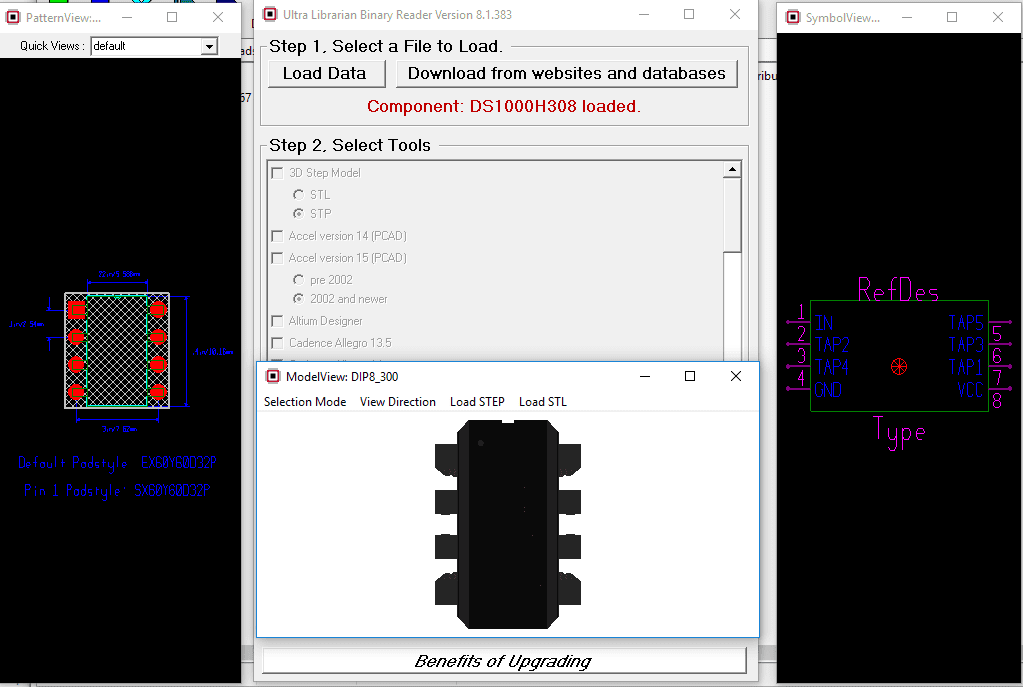
CREATE SYMBOLS, FOOTPRINTS, AND 3D MODELS FROM PRE-AUTHORED DATA

ULTRA LIBRARIAN FREE READER

Preview models prior to downloading

Choose from over 20 different CAD export options

soundfont to dwp
CONVERT BXL FILES INTO YOUR PREFERRED CAD FORMAT

The free reader is a lite version of Ultra Librarian specifically designed to import vendor neutral CAD data (.bxl files) from manufacturers’ websites and then export symbols, footprints, and 3D models to specific CAD tool formats. The reader is a read-only tool and will not allow users to make any changes to the data. For symbols, footprints, and 3D model creation capabilities, use one of the Ultra Librarian Desktop Software options.

BXL FILES FROM YOUR FAVORITE IC MANUFACTURERS

Many of our IC partners offer BXL files for their components directly on their websites. Once you have obtained a BXL file it is quick and easy to convert to your preferred CAD format through our online BXL conversion tool.

Check out all manufacturers here.

EXPORT TO OVER 30 DIFFERENT CAD FORMATS

VENDOR NEUTRAL FILES

Accel EDA 14 & 15

  • DesignSpark
  • Mentor Graphics
  • BoardStation
  • Mentor Graphics Design Architect
  • Mentor Graphics Design
  • Expedition 99 and 2000
  • PCAD 2000, 2001, 2002, 2004, and 2006
  • STL
  • TARGET 3001!
  • View Logic ViewDraw
  • Zuken CadStar 3 and 4
  • Zuken CR-5000 and CR-8000

FREQUENTLY ASKED QUESTIONS

A .BXL file contains electronic data created by Ultra Librarian in a universal format and is used for distributing PCB information. .BXL files can be opened by the Ultra Librarian Free Reader and translated into your choice of 22 different CAD formats.

Ultra Librarian has partnered with major IC manufacturers to create electronic data representing their parts and are available to the public. Partners include Analog Devices, Texas Instruments, Microchip, Maxim, Silicon Labs, Renesas, Exar, and NXP.

Yes, you can use our Online Reader if you don’t want to download the Free Reader

Free Reader

"*" indicates required fields

Soundfonts are a type of file format used to store and playback sampled audio. They are essentially a collection of audio samples, along with metadata that describes how those samples should be played back. Soundfonts are widely used in music production, particularly in the context of virtual instruments and software synthesizers. They offer a convenient way to access a wide range of sounds, from orchestral instruments to electronic textures, without the need for expensive hardware.
Converting soundfonts to DWP offers a wealth of creative possibilities for musicians, producers, and composers. By following the steps outlined in this guide, you can unlock the full potential of your virtual instruments and take your music production to the next level. Whether you're looking to improve sound quality, increase compatibility, or access advanced features, soundfont to DWP conversion is an essential tool in your music production arsenal.

DWP, or Dream sampler Waveforms and Presets, is a proprietary file format developed by Korg. It's used to store and playback sampled audio, as well as presets and other data, on Korg's range of synthesizers and samplers. The DWP format is known for its high-quality sound reproduction and flexibility, making it a popular choice among musicians and producers.

As a musician, producer, or composer, you're likely no stranger to the world of virtual instruments. Two popular formats that have gained significant traction in the music production community are soundfonts and DWP (Dream sampler Waveforms and Presets). While both formats offer a wealth of creative possibilities, converting soundfonts to DWP can be a game-changer for those looking to tap into the vast sonic capabilities of the DWP format. In this article, we'll explore the ins and outs of soundfont to DWP conversion, and provide a step-by-step guide on how to make the transition.

the pcb design, assembly, and trends blog

RELATED CONTENT

Soundfont To Dwp May 2026

Soundfonts are a type of file format used to store and playback sampled audio. They are essentially a collection of audio samples, along with metadata that describes how those samples should be played back. Soundfonts are widely used in music production, particularly in the context of virtual instruments and software synthesizers. They offer a convenient way to access a wide range of sounds, from orchestral instruments to electronic textures, without the need for expensive hardware.

Converting soundfonts to DWP offers a wealth of creative possibilities for musicians, producers, and composers. By following the steps outlined in this guide, you can unlock the full potential of your virtual instruments and take your music production to the next level. Whether you're looking to improve sound quality, increase compatibility, or access advanced features, soundfont to DWP conversion is an essential tool in your music production arsenal. soundfont to dwp

DWP, or Dream sampler Waveforms and Presets, is a proprietary file format developed by Korg. It's used to store and playback sampled audio, as well as presets and other data, on Korg's range of synthesizers and samplers. The DWP format is known for its high-quality sound reproduction and flexibility, making it a popular choice among musicians and producers. Soundfonts are a type of file format used

As a musician, producer, or composer, you're likely no stranger to the world of virtual instruments. Two popular formats that have gained significant traction in the music production community are soundfonts and DWP (Dream sampler Waveforms and Presets). While both formats offer a wealth of creative possibilities, converting soundfonts to DWP can be a game-changer for those looking to tap into the vast sonic capabilities of the DWP format. In this article, we'll explore the ins and outs of soundfont to DWP conversion, and provide a step-by-step guide on how to make the transition. They offer a convenient way to access a